Tag: AI Booster

INNOwork #02: Workshop “AI Know-How meets AI Challenge”

Du kennst dich mit KI aus und suchst einen konkreten Anwendungsfall um deine Expertise einzubringen?

Dann stell dich den Herausforderungen unseres Industriepartners.
Tauche ein in die spannenden Fragestellungen aus der realen Welt, diskutiere zusammen mit weiteren Expertinnen und Experten mรถgliche Lรถsungsansรคtze und รถffne die Tรผr zur Entwicklung tragfรคhiger Lรถsungen.
Die Teilnahme ebnet dir den Weg zu einer Projektfรถrderung durch Innosuisse und kรถnnte der entscheidende Schritt sein, deine Idee Realitรคt werden zu lassen.

Der Workshop wird in Kooperation mit dem Innosuisse Innovation Booster Artificial Intelligence durchgefรผhrt.
Fรผr die Teilnehmenden an dieser Veranstaltung besteht im Anschluss die Mรถglichkeit, ihre Ideen gemeinsam mit einem Konsortium im Rahmen der Fรถrdermรถglichkeiten
des Innovation Booster Programmes weiter zu schรคrfen.

ABLAUF

  • 14:00 Uhr: Registrierung und Socializing
  • 14:30 Uhr: Begrรผssung, Zielsetzung, Ablauf
  • 14:45 Uhr: Start des Workshops
  • Vorstellung der Challenges
  • Aufteilung in Kleingruppen
  • Shaping, Challenging and Ideation
  • 17:45 Uhr: Wrap-Up & Follow-Up
  • 18:00 Uhr: Ende des Workshops
  • 18:00 Uhr: Apรฉro und Networking
  • 19:30 Uhr: Ende der Veranstaltung

ZIELGRUPPE & SPRACHE

  • Offene Veranstaltung fรผr alle Personen, welche mit KI zur Lรถsung konkreter Herausforderungen beitragen wollen, d.h. insbesondere aus Start-Ups, aus Lehre und Forschung, aus der Welt der KMU und der Verwaltung
  • Der Workshop findet auf Deutsch statt. Fragen kรถnnen gerne auch in Englisch gestellt werden.

VERANSTALTER

Moderationsteam der swissICT Fachgruppe Innovation (Emilie Etesi, Viktoria Mauz, Violeta Lozano, Harald Bader) & Geschรคftsstelle swissICT (Carol Lechner) in Kooperation mit dem Innovation Booster Artificial Intelligence (powered by Innosuisse) (Reik Leiterer).

KONTAKT

Carol Lechner, Geschรคftsstelle swissICT: event@swissict.ch

KOSTEN

Kostenlos. Bitte informiere uns so schnell wie mรถglich, falls du nicht teilnehmen kannst.

Innovation Booster Stories – Radical Innovation through Digitalization

A series of lunch & afterwork webinars showing radical innovation emerged from the Innovation Booster program powered by Innosuisse

Do we have the courageโ€”and the enduranceโ€”to pursue truly radical ideas? 

Most so-called โ€œmoonshotโ€ ideas donโ€™t fail because they lack potential, but because the risks feel too high and markets are misunderstood. Weโ€™re here to change that mindset.

Through theย Innovation Booster Program, powered byย Innosuisse, we transform high-risk challenges into collaborative and desirable opportunities:

Exploreย โ€“ Solve complex challenges within an open innovation ecosystem

Supportย โ€“ Receive financial backing for selected early-stage ideas

Growย โ€“ Benefit from targeted coaching to navigate uncertainty


Innovation Booster Stories brings together projects from different Innovation Boosters to pitch their radical ideas on topics that matter across the Innovation Booster communities. Each session features bold early-stage projects, diverse audiences, and focused peer feedback.

ย Format

  • 3-minute pitch per project
  • 3 minutes of silent feedback from the community
  • A highly diverse audience from multiple IB communities, contributing a wide range of expertise and perspectives

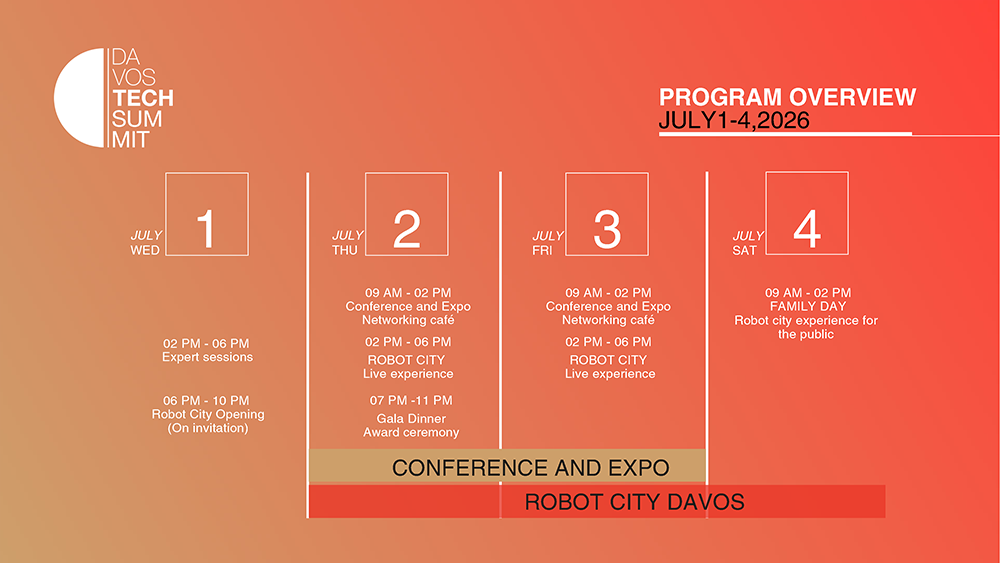
TOUCHING INTELLIGENCE – DAVOS TECH SUMMIT

From stage conversations to city-scale encounters, Davos Tech Summit is designed as an immersive experience around robotics, physical AI, and real-world deployment. With the conference and the Robot City, Davos becomes a living laboratory for the near future. Find more information on the official website.

Expert Group Meeting โ€“ Natural Language Processing in Action: Corporate GenAI

We are happy to invite you to our next NLP Expert Meeting on April 16th, 2026, at our regular venue – ZHAW on Lagerstrasse – followed by an apรฉro at Nรผรผ. In this session, we will focus on โ€œCorporate GenAIโ€ and will as always feature three great speakers.

  • Holger Keibel from Karakun will show how a โ€œSearch first, then RAGโ€ workflow improves the accuracy and relevance of RAG responses, puts the user in control and scales as a knowledge access strategy.
  • Norbert Kremer will reveal how Panter helps the Swiss Post keep 10โ€™000+ corporate pages up to date using AI-assisted workflows.
  • Albert Weichselbraun and Silvan Wiedmer from Fachhochschule Graubรผnden will talk about their research on neurosymbolic AI for developing confidential and reliable assistants for high-stakes environments in the financial sector.

Join us on April 16th at 17:30 at Lagerstrasse 41/45, 8004 Zurich. The presentations will take place from 17:30 to 19:15, followed by the apรฉro downstairs from 19:15 onwards.

For those unable to attend in person, online participation is also available.

Please confirm your attendance by April 12th using the following form:

MOSAIC Shaping Workshop

MOSAIC (Multimodal Open-Science AI-Powered Integrative Computation) is an initiative to build the missing infrastructure layer for next-generation research on humans: a platform for synchronized multimodal physiology + behavior + subjective reports enabling scalable and reproducible neurophenomenological and clinical research.

Today, sophisticated multimodal studies (EEG, audio/video, speech, physiology, psychometrics, experience sampling) remain difficult to conduct due to fragmented tool ecosystems, high expertise requirements, and critical bottlenecks in signal synchronization and integrated processing.

The MOSAIC Shaping Workshop ยซFrom fragmented multimodal studies to scalable multimodal science infrastructureยป brings together leading experts from neuroscience, multimodal AI, research infrastructure, clinical research, and innovation to:

  • evaluate feasibility and innovation gaps
  • define a tractable MVP and implementation pathway
  • shape the roadmap toward follow-up funding and prototyping

Event Information:

Thursday, February 19, 2026

Expert Evaluation
Time: 09:00 – 14:00
Venue: Digital Society Initiative (DSI),
University of Zurich (SOC-E-010)
Address: Rรคmistrasse 69, 8001 Zurich

Tentative agenda:

  • Opening โ€” Welcome; genesis story; project introduction
  • Short Participant Introductions
  • Network Mapping (people, disciplines, infrastructure, funding)
  • Coffee Break and Networking
  • Data Types Exercise (participant input)
  • Implementation of MOSAIC
  • Standing Lunch
  • Research Questions and Pilot Projects
  • Innovation Gaps and Collaboration

Core Team Meeting
Time: 14:00 – 16:00
Venue: Digital Society Initiative (DSI), University of Zurich (SOC-E-006)
Address: Rรคmistrasse 69, 8001 Zurich

Tentative agenda:

  • Summary of the expert evaluation
  • Next steps

Friday, February 20, 2026

Implementation Strategy
Time: 09:00 – 12:00
Venue: Kleine Aula, University of Zurich (RAA-G-01)
Address: Rรคmistrasse 59, 8001 Zurich

Tentative agenda:

  • Implementation plan
  • Business plan
  • Current state of the technology
  • Pilot projects
  • Target customers
  • Funding strategy

Radical Innovation for Social Impact Webinar

Find more information and registration on the official website

Do we have the courage to pursue truly radical ideas?
Most “moonshot” ideas failโ€”not because they lack potential, but because the risk seems too high. We are changing that mindset.

Through the Innovation Booster (IB) program powered by Innosuisse, we turn high-risk challenges into collaborative opportunities:

Explore: Solving problems within an open innovation ecosystem.
Support: Financial backing for selected early-stage ideas.
Growth: Targeted coaching to navigate uncertainty.

Weโ€™re excited to highlight “Radical Innovation for Social Impact,” featuring projects that are pushing boundaries to create a better world. See firsthand how the IB process supports bold thinkers.

Human Factor Challenges of GenAI Implementation in Organizations

UZH.ai Hub is organizing a hackathon: โ€œHuman Factor Challenges of GenAI Implementation in Organizations: Business-Academia Hackathonโ€ on April 8 and 9, 2026, in Zurich. As the name suggests, they would like to concentrate not on the technical challenges but rather on the human side of GenAI implementation. The rapid adoption of generative AI (genAI) presents both immense opportunities and significant challenges for companies navigating digital transformation. Many organizations struggle to identify practical use cases, prototype solutions, and integrate these technologies effectively into existing workflows. Simultaneously, students are eager to apply their academic knowledge to real-world problems, bridging the gap between theory and practice.

This hackathon proposes to create a dynamic collision between these two worlds, fostering innovation and forging valuable connections between the next generation of talent and the companies shaping our digital future. The event is initiated by UZH.ai, and supported by the Digital Society Initiative of the University of Zurich and the Center for Leadership in the Future of Work. In addition, the main strategic partner is the Data Innovation Alliance, a community supporting innovative ideas of experts and researchers, enabling the development of new solutions โ€“ successful in the market, and accepted by society.

They would like to invite interested organizations from industry to collaborate and contribute to the discussion on the current implementation challenges of generative AI and mentor students during the Hackathon.

Workshop – Unlocking End-to-End Automation: Seemless Logistics with AI, Humanoid Robots & Level 4 Autonomous Vehicles

Together with Planzer as Challenge Partner, we invite you to a hands-on workshop bringing together startups, SMEs, corporates, researchers, students, cities and public authorities to explore how AI-driven orchestration, humanoid robotics and Level 4 autonomous vehicles can enable scalable, resilient and real-world end-to-end logistics automation beyond autonomous driving.

A Call for Disruptive Logistics Solutions

1) Solving the Sender-to-Hub Puzzle
We are looking for scalable solutions to tackle the critical inefficiencies of the sender-to-hub process. This includes possible solutions regarding load planning and improper cargo distribution, ideas around dock congestion and packaging errors, and how to optimize the manual handling tasks towards automatic and autonomous workflows. Software solutions for seamless integration and comprehensive solutions also play a role here, from automated data capture to AI-driven time slot management.

2) Robotic Load-Flow: Automating the Railway Hub
We are seeking innovation in industrial robotics and conveyor technology to revolutionize the interface between rail freight and automated sorting. The challenge is to develop solutions for the automated loading and unloading of railway wagons, managing highly heterogeneous cargo within extremely tight time windows. We prioritize systems that can autonomously bridge the gap from wagon to sorting belt, handling varying load carriers with precision and speed.

3) The Touchless Mile: Automated Parcel Exchange
The last mile remains the most expensive and complex logistics segment, primarily due to the inefficiency of manual drop-offs in dense urban environments. How to solve physical automation with the focus on creating delivery robots and autonomous vehicles that can safely navigate unpredictable sidewalks and “curb-to-door” obstacles? And how to standardize automated recipient interfaces, such as smart lockers or secure robotic hand-off points, to eliminate failed delivery attempts and high labor costs? We are looking for innovation around integrating these hardware solutions with smart city infrastructure to ensure seamless, contactless goods transfer.

What’s happening at the workshop?
We will explore concrete barriers and opportunities across the logistics value chain, from loading and unloading to last-meter delivery, customer interaction and deployment in complex urban environments. Expert inputs and collaborative breakout sessions will focus on practical approaches, system integration and pilot-ready directions.

Why join?
Work on a real industry-driven challenge together with Planzer
Exchange with experts from logistics, AI, robotics and mobility
Develop approaches that can be submitted to the challenge after the workshop
Selected teams receive up to CHF 25โ€™000 in project funding and expert support for pilot projects

The workshop is led by Switzerland Innovation Park Central, the Innovation Booster New Mobility, the Innovation Booster Artificial Intelligence and the Swiss Robotics Association in collaboration with ETH Zรผrich, EPFL, Lucerne University of Applied Sciences and Arts and the University of St.Gallen.

Have any questions? Reach out to Deniz Pรผseli deniz.pueseli@unisg.ch โ€“ heโ€™ll be happy to help you.

We are looking forward to your participation!

Innoday 2026: Artificial Intelligence (AI) and its significance for promoting innovation in Switzerland

The Innoday is Switzerland’s public innovation funding conference and is open to invited guests. The conference is organized by Innosuisse and SECO in collaboration with the Conference of Cantonal Ministers of Economic Affairs and this year’s host canton, Zug. regiosuisse provides support with the organization and implementation.

We are involved with a break-out session about: “Why AI projects don’t work โ€“ experiences from 6 years of Innovation Booster”. In the context of digitization and digital transformation, methods and concepts from the field of artificial intelligence have become indispensable. However, what is communicated in the media as a solution to (almost) all challenges is often difficult to implement. Using practical examples, we discuss the hurdles that need to be overcome to create value as well as reasons that can lead to AI projects failing.

Subscribe to our newsletter:
=